This is a pretty straightforward thought that seems to relay a complex design issue in games. Very often, game designers construct a beautifully elaborate experience, only to have it all go to hell once it gets in the hands of the audience.
Who is to blame for those problems? Is it the designer that is so stuck in his or her thoughts that only after daily practice in their own system do they understand it? Is the audience so attuned to gameplay of other games, you pretty much have to shrug your shoulders as a designer and go with the flow?
For the audience member, that may seem like it is the only solution to do what audiences feel is familiar, but this does come with a cost. If we were to make a FPS game, most likely we would make the control scheme and feel of the game very similar to Call of Duty. Why? Because chances are if you are near electricity, you have heard of Call of Duty. It was such a large hit that it becomes a simple way to educate the audience for any other FPS. Didn't play Call of Duty or didn't like Call of Duty? Well too bad, because if we only do what the audience is familiar, then expect a whole lot more of the Call of Duty experience. You will never get a Portal, Bioshock, or TF2. Just not in the cards. Game design then becomes a cliche machine.
So somewhere there needs to be a balance, or else game design is a dead art. And this is where the kitchen comes in.
Nearly everyone's kitchen is different. Kitchens come in various sizes, shapes, and colors. The components in them support what kinds of cuisines or normally cooked. Different people come from different backgrounds, and make different foods, so on and so on.
However, if we dropped an average person into just about any kitchen in the world, they would be able to identify fairly quickly that they are in a kitchen. It doesn't matter whether it is in Japan, Russia, or the U.S. It could be a commercial kitchen or part of a home in Nicaragua. We are able to identify very quickly key elements in the room that must have something to do with the cleaning and preparing of food. Usually some food storage and something that generates a lot of heat next to each other is a pretty good give away.
Now go into a kitchen that you've never been in before. Find a glass to pour yourself a beverage. Chances are you will go to the approximate location you are used to in your own kitchen. And chances are there will be anything but a glass or cup at that location. Somewhere in this space is the implement you need, but now you need to learn this space.
Game design does not have this luxury. If a player goes to the spot where they expect an ability (similar to looking to a glass in a different kitchen) they immediately go into frustration when it does not work as expected. This is not because of some stunted tolerance for change, as I'm sure many baby-boomers will point out. Instead it is a problem of context. We play games to enter a state of flow (read Mihaly Csikszentmihalyi) so that behaviors in game that in all other context should be work, instead is an enjoyable experience. Failing to enter flow brings the task at hand back into work, which is exactly the opposite reaction we desire from games.
For game designers, we need to design our kitchens so that most people can go into them and begin using them at a near-expert level immediately. They should not wonder where the cups are. Instead we should make cabinets with glass doors so you can see where the cups are. If the player is used to a gas range but we only have electric, provide some quick UI that helps translate what the difference means. Can't find a specific ingredient? Well that's okay too because we are going to give you big arrows that point to suggested alternatives in the specific moment you need them.
Showing posts with label Design. Show all posts
Showing posts with label Design. Show all posts
Monday, June 25, 2012

Monday, April 16, 2012
Mass Effect 2 Retrospect
In a natural progression from my recent ME1 retro, I'm diving into ME2. Just like before I will present what was good and not so good from a developer's perspective. The bar is a little higher for this game since it doesn't suffer from new IP syndrome, nor have as many issues with the Unreal engine.
And yes, after this, you can expect some ME3 play.
And yes, after this, you can expect some ME3 play.
Wednesday, March 28, 2012
Mass Effect 1 Retrospect
A review from a game design perspective
So a little while back I promised that I would play through ME1 with my designer cap on. I would evaluate the game not on the limitations of the engine as I too was developing on the Unreal engine at the time and know what came easy and what did not. I would look at the intentions of the designers and point out what really worked, and what really didn't.
I do need to mention that I do respect the work that Bioware and EA have done, and not just because I have friends on their development teams. I also should mention that I will not warn of spoilers. The game has been out for years. Vader was Luke's father. Rosebud was the sled.
Well I finished a full playthrough and here's what I noticed.
Basics
Since no two playthroughs of this game are identical (which I do find a huge plus to the design), here are my initial specs of my Shepard:
- Male
- Earthborn
- Ruthless
- Infiltrator
Content issues and the UI
The biggest hurdle in creating an RPG is the content. Most games need to follow a bible just for creating a linear experience. Once you branch the experience, or allow for sandbox play, you are quite literally creating a world of content, and all of it must be seamless.
Somehow, UI design is usually one of the last items developed. How are we to know what goes into the menus if we don't know the content yet. UI tends to follow behind everyone else, which is also why the last big bugs and heaviest crunch falls on these guys near the end of development. People tend to ignore UI when it is flawless, and are relentless about it when it is not.
Though there are other articles online (like this one) about the specifics of UI flaws in ME1, I really find the issue to be a disparity between presenting a vast ocean of content from the very first screen, while keeping the stuff on screen still somewhat digestable. I feel ME1 came close, but was off enough to cause issues.
For example, the character creation assumes quite a bit from the player. If I pick an Adept, the games tells me that I am the ultimate biotic, with starting talents of barrier, throw, and warp. Great! What's a biotic? What's throw and barrier in terms of this game? Are they good choices? Do they fit with the character I have already built in my head before starting the game (for me it was Malcolm Reynolds)? I haven't a clue what I'm going into, but I need to make these very important choices before any content exposure, with no chance of going back. If I don't like the choices, then I have to go back and recreate everything from scratch and begin again.
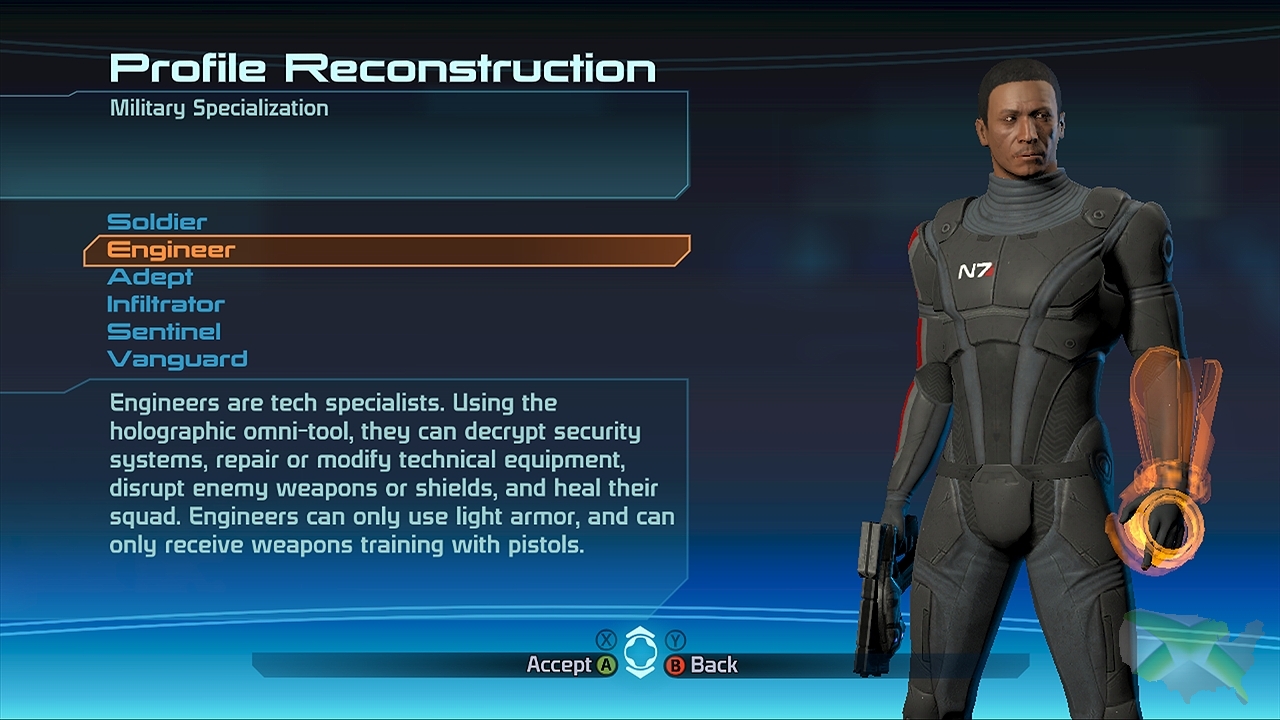
Is Psychic a choice? 'Cus it should be.
This disparity between content and UI I feel is one of the biggest detractors of the game. The first time I played through back 5 years ago, I stopped after I became a Spectre and earned control of the Normandy. My issue then was the game switched from a guided experience to a sandbox (with some direction). I was not ready for the sandbox, and looking into the galaxy map the first time, I just went "Whoa". I picked a planet at random, landed, and was promptly destroyed by a Thresher Maw. Rinse and repeat a few times, and I was done.

In Star Trek Voyager, these distances would have taken 75 years to travel. That's a long way to go to Panda Express at Warp 9.
In this playthrough, I was gone from beginning to end. I've realized there are pointers to help guide you through the space now, which is a nice touch but not enough. I also had a series of combat powers, that even after finishing the game, I'm still not sure what they do. I do know that sabotage and damping had more significant effect on killing off geth, but I could not tell you what those powers did. I haphazardly blasted powers in the direction of enemy bots rather than use any real strategy to combat.
Terrain and the Mako
I find the Mako experience kind of a fascinating one, mostly because I imagine what the paper design and execution was like. We want the player to land on alien worlds with harsh environments. We want to give them a vehicle that can traverse difficult terrain. Then the execution process must have been a tennis match war between the vehicle team and the terrain team on who could be more absurd.
I see the terrain team looking at the terms "alien", "difficult", and "harsh" and just running with it. This is actually a good thing. Frequently in game development, the devs try to create the most accurate feature they can, only to find out they need to rebuild it because it was not what the Director or EP was thinking. Sometimes it is better just to go to 11 with the feature, and then you can tune it back down. And if we are bothering with scientific accuracy, alien worlds do tend to be very cratered and spiky. There isn't a lot of weather on other planets eroding away the harsh edges. Mountains on other planets are razor sharp. It was clear that the terrain team did their homework.

Mars will eat your car's tires
At this point, the Mako team probably caught wind of the terrain teams work, most likely through a producer. This is exactly the kind of trouble we producer cause. They went back to their Mako variables and then set them to 11 to handle whatever the terrain team could be making. What resulted was a tank that could drive over anything with an almost Spider-man-like ability to climb up walls. It had cat-like reflexes so that it never turtled. And most importantly it had rockets just in case.
Here's where I question the design. Why make sprint the same button as rockets? As a natural reaction as a player, I want to give the Mako a little extra gas to get up the hill. Instead I fly back off the hill wall and have to restart.
Then this mix got into the hands of the level designers, who rightly put hard to find objects across the map. But this whole combination is a cocktail to frustrate the player. The first planet is interesting, but the facade quickly breaks down on retrieval quests. Throw in almost impossible to traverse mountains in the way and a vehicle that can somehow crawl up them and someone is not evaluating this level's gestalt. There is a difference between making the objective of a game difficult with clear and harsh obstacles, and making objectives difficult through no-though tedium.
Cinematics and Story
This team had to create so much cinematic content, I'm actually impressed that they fit it onto one disc. Seriously. I have no problem that animations in most conversations tended to have the same head bobs and shuffles. I actually was able to suspend that nitpicking and really enjoy the story this time through.
Back when I first tried ME1 and quit at the galaxy map, my fellow developers told me I at least needed to keep going because the story was worth it. My personal feelings at the time (and still is) is that games are not an effective narrative delivery service. If you want to tell a good story, make a movie or write a book. In a game, the player becomes an active participant, and they are going to ruin whatever you had in mind. This is a good thing in games, but rarely do I buy into a game for the narrative.
But the ME folks did a really good job. I felt that they led me in the overall narrative when necessary, but allowed me to go off in any direction I wanted. Creating a non-linear narrative means you will need funnel points so that you can keep the overall direction together. Otherwise you would hit a branch in the story and then have to load a new disc (remember those PC gaming days?).
The ME1 story followed the classic cowboy narrative. A lone gunman encounters a corrupt sheriff, and in turn becomes the new sheriff. A motley crew of misfits that didn't fit with the old ways system join in with our hero, some reluctantly. In the end there is a gunfight between new and old law. Most likely some reveal about how the sheriff was really just protecting folks from a bigger evil. If you have no idea what I'm talking about, go out and rent Unforgiven or any movie by John Ford.

When you leave a man at the Ilos Conduit, you better make sure he's dead.
It would have been nice to see the pre-story story that you select to help sell your version of Shepard, but again I understand that this game had to ship too.
So well done Bioware. And if you can translate John Wayne's character in the Searchers into ME4, then I would be impressed. And I'm still not sure whether that character killed his own niece in the canyon or not, but I'm sure he did. I'm also sure Shane died at the end as well, though they never showed it.
Save/Loads
This was the largest point of frustration for me. Main narrative events seemed to be sprinkled with occasional automatic saves, but few too sparse. Other planets only saved when you landed, in the hopes that you could do everything and leave before you need to save again.
But Unreal bots with rocket launchers have a tendency to be a little cheap. You can mow through a 100 bots without issue, only to have a rogue geth knock you out in one hit. Then you go an hour of gameplay back. That's just not right.
And yes I am aware there is a user save option when not in combat. After the first few hours lost, I spammed this option like a bunny in heat. Not an ideal play condition when I feel my time invested is constantly at risk.
Here's an example. The Thorian's Lair, which has a handy save point just before the entrance. As a player, you enter and engage in a cut-scene dialogue tree. Then some combat. Another cut scene. Combat, cut scene, combat, final cut scene of Thorian dying. There's even an achievement for this moment. But if you leave this space and are killed by a rogue geth you left on the planet and did not save, you go all the way back to the entrance to the Thorian's Lair. It's like the neverending portal slide, only less awesome.
Conclusions
I really enjoyed this game the second time around, much more than what I gave it credit for back when it first came out. There are quite a bit off issues, but there are for the first game of any IP. Any diehard COD1 players out there? There is a lot of forethought in the first game and you can buy into the vision for future (now past) endeavors. I'm picking up ME2 to see if they fixed the issues above, because if so, I'm sold.
Saturday, March 17, 2012
Looking Back on Mass Effect
Back in 2007 I was well into development on Frontlines: Fuel of War, which we were developing on the Unreal engine. Though Unreal had been around over a decade, the newest version was just starting to see title launches on Xbox 360. So far we had seen a very successful launch with Gears of War, but from a developer standpoint, the engine was built to make that specific game. If you were creating a console title on Unreal then, you studied every other Unreal engine based game as it came out.
When Mass Effect originally came out, we swarmed it because it diverged the farthest from Gears in design to that date. Many developers heralded it as GOTY (though in tight competition with CoD4:MW and Portal).
Back then, I played up until Shepard becomes a Spectre and can travel anywhere in the galaxy. This is where my confederates claimed the game really started to become good. But I felt I had experienced enough of the game for my taste and moved on to other titles. To be honest, most developers only play the first few levels of a game before moving on.
Now that we're at ME3, I figured it was due time to go back and take a look at the series. I'll play from the beginning and evaluate the game purely on design choices, as many of the issues in previous reviews were due to limitations of the engine at the time (long elevators, odd animation for female characters, odd lighting issues, texture popping). I'll go back and record my progress and insights.
So here we go...
When Mass Effect originally came out, we swarmed it because it diverged the farthest from Gears in design to that date. Many developers heralded it as GOTY (though in tight competition with CoD4:MW and Portal).
Back then, I played up until Shepard becomes a Spectre and can travel anywhere in the galaxy. This is where my confederates claimed the game really started to become good. But I felt I had experienced enough of the game for my taste and moved on to other titles. To be honest, most developers only play the first few levels of a game before moving on.
Now that we're at ME3, I figured it was due time to go back and take a look at the series. I'll play from the beginning and evaluate the game purely on design choices, as many of the issues in previous reviews were due to limitations of the engine at the time (long elevators, odd animation for female characters, odd lighting issues, texture popping). I'll go back and record my progress and insights.
So here we go...
Subscribe to:
Posts (Atom)
Subscribe To


 Posts
All Comments
Posts
All Comments