Showing posts with label producer. Show all posts

Tuesday, July 3, 2012

Game Production – Back to the Kitchen Analogy

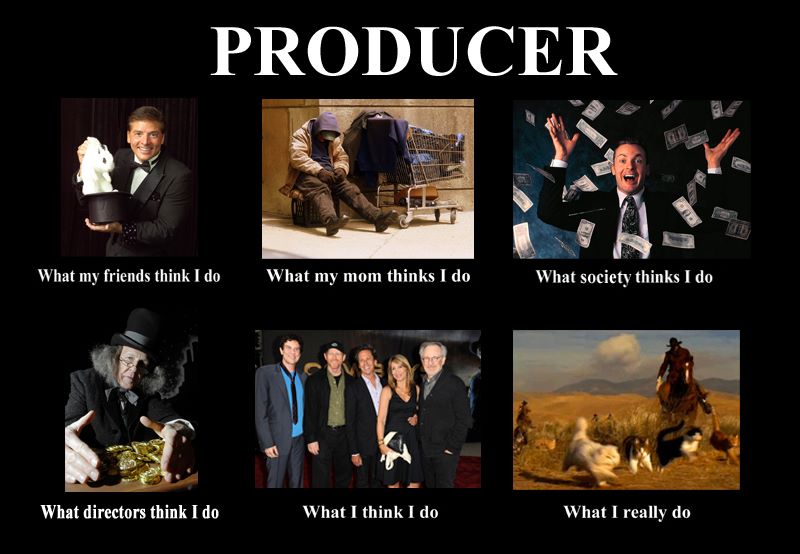
I have been a game producer (or variant of the role: project manager, product owner, product manager, pain-in-the-ass) for 6 years and counting. I’ve worked 2-month game projects with bare bones teams to massive 3-year blockbusters where it seems the sun never sets on some part of the development. One question continually comes up when people find out what I do, and that questions is, “can you fix my PS3/Xbox?” The answer is no. Check if your console is within warranty, but at this stage of the console cycle it is only 18 months for the next round of tech to be out. The second most common question I get is, “what exactly does a producer do?

This image is so 6 months ago

This is extremely difficult to answer and it seems no one really knows. The title changes from studio to studio. Most often in interviews for a producer role, I am usually asking that studio what does a producer role mean in this office. It’s a bit of an anomaly. Designers, artists, and programmers have a sense of familiarity and process of the daily grind as they move from job to job. And the life of anyone in entertainment tends to be very gypsy-like as projects begin and end or studios open and shutter. But producers are enigmas. We can sense each other and share in the pains and processes, but for the most part we are in the roles that don’t actually make anything, so it is rather tough to say what is it that you actually do as a producer. Much like the definition of what a game is, I’ve heard various descriptions during my time, but none of them really fully explain the job. “Producers are the net that catch all the spinning plates and if a plate falls, they put it back on the stick.” “Producers are the cattle prod behind all developers.” “Producers are a carrot on the stick and a boot in the butt.” “Producers make pretty spreadsheets and let us know how far behind we are.” “Producers are annoyances that stop by desks and remind you how stressed you are.” “Producers get the best desks, the second largest paychecks, and figure out how everything is going to be completed.”

For the last 6 years of doing my job, I still have a very hard time describing what it is that I do. Then I was faced with a home repair job that felt very much like what I dealt with day-to-day and I believe becomes an excellent metaphor for game production.

At around 3am on a weekday night (which is when all home catastrophes happen) I awoke to find a non-trivial amount of water in my kitchen. Since this was 3am, everything moved forward in my brain in slow motion as I connected the pieces while scanning the kitchen through only one open, yet bleary eye. Though it took an age to figure out without the help of caffeine, the mystery of the new lake in my kitchen turned out to be the result of a leaky pipe and my dishwasher water now emptying out everywhere except the pipe it was meant to go through.

My expertise in plumbing came from TV. So I beat my head with a pipewrench and jammed a finger into my eye.

I mopped up the water before it caused any damage while spilling out a litany of curses strung together in a tapestry of colorful expression ranging from the obtuse to just plain rambling. A coffee and flashlight later, I found a fragged P-trap under my sink that was letting out all of the water. Once I had removed the problem piece, I was faced with an unusual problem: how do I fix this mess?

My home is a century old. No, literally. It was built just before the Titanic set sail. Much of the construction of my house is new tech over old tech. You can make out where the coal used to be shoveled in from the driveway. The electric is a bizarre series of systems rather than room-by-room (one breaker controls lights in the kitchen, hallway, dining room, master bed room, and guest room, but nothing else). Much of the basic structure of the house was built in a time when there was no set standards and many things were built by hand with what was available nearby. This was the case with my sink drain.

From the floor I had a steel pipe sticking straight up at a non-standard width. Clearly this had been around since the Downton Abbey days. Coming down from the sink was a modern steel pipe of standard size. And this two pipes were about two-feet apart from each other.

Skype?! But how will it replace my complex system of pull-string bells?


Once I had arrived at the Home Depot (which opens extremely early for contractors and home owner catastrophes) I realized an additional dilemma. All modern P-traps are made of plastic. I needed to go from steel to plastic and back again, spanning across the inside of my cabinet while all connections being watertight and letting gravity do the work.

This is where the production part kicks in. As a producer, you are the first one to take a step back and evaluate the situation. It does not matter whether you are creating a new innovation in gaming or you are just polishing a game feature in Madden '13 that has existing since Madden '88, you will be faced with something where there is a significant translation problem, and the piece to fix it is not ideal. Nearly every dev can create solutions, but it is up to the producer to find the optimal solution. Fixing a sink may not have any effect on the electric, but in a game system it very well could be connected.

Someone in Tiburon is coding a Turkey Leg feature. This man knows what I'm talking about.

The producers job is the get everything from the sink to the drain in the fastest, cheapest, and best possible way, even if that solution is ugly as hell. A producer does not necessarily do the fix him/herself, but they should be familiar enough with every other working piece that they can make calls and suggestions for the developer to get the fix in right the first time. If they were good enough, they saw the problem before anyone else and had all the parts ready for when that day came. Producers are planners, translators, and problem-solvers. They excel when they are presented with a situation that there is no set process and they need to make something impossible happen. No one tells you how you are going to produce a Game with Fame event with Slipknot while they are in tour in Tokyo and your are in Manhattan, but as a producer you figure it all out.

Nice guy and a Frontlines fan. Who knew?

What I purchased from the Home Depot that morning was a bizarre collection of parts that formed together into a MacGyvered interpretation of a P-trap. It worked flawlessly and I still had time to eat breakfast and go  to work on time. To this day I have not had a single drop of water come out of this system, so for the time-being, I do not have to deal with swimming in my kitchen.

Thursday, May 17, 2012

What Makes a Good Game Producer?

Defining the role of Producer

Nearly every producer in entertainment is asked the same question: "what does a producer do?"

The definition of a producer changes in every studio. Sometimes they are more like project managers, handling the budget and schedules. Sometimes they are more like design directors, holding the vision of the product and seeing that every aspect meets that core direction. Sometimes they are firefighters, solving problems in rapid succession, usually because no one bothered with the core vision, budget, or schedule in great detail. Other times they are whatever the company needs at that moment, swapping hats as designers, programmers, QA, or artists, as they know just enough about each area to do beginner-level work.

There simply is not a good definition for what a producer does, because the true answer is "everything".

For the producer, this creates a bit of a problem in work assessment. Are you doing a good job? Well did you do "everything" today? As a producer on various products, usually I'm judged by my superiors on the quality, efficiency, and frugality in whatever area I happen to be in charge of for the product. To the publishers and most of the outside world, I'm judged on how good the end result of the area of the product turned out in retail, even though many of the decisions of that product were made well above my payscale.

I produced Homefront single-player campaign, so go ahead and judge.

Lessons from a Film Crew

When I worked in film, I was taught a simple rule to know when you see a good producer: "they are the ones sitting, talking on the phone all day about the next film". On a film set, every detail of every job is clearly defined to the person doing that job. You dare not pick up an apple box unless your title has Grip in it. Do not even try to plug in anything electric unless you are on the Gaffer's team. It is frequent on a film set to see a group of perfectly capable crew standing next a 5-pound object that needs to be moved for the next shot and refusing to touch it as if it were covered in razor blades and excrement. Instead they radio over to the one whose job it is to move that object and have them come in from a hundred yards away.

Mr. Cruise is on the set. Someone radio a Grip to move his "leveling device"


This might sound like insanity, especially when you are new to a set. The common complaint aired by crew members is "hurry up and wait" because they cannot move ahead with their job until a blocker is handled by the specific person that handles that specific blocker. Surely the whole production could save time if only I could plug in my own plug or lift a simple box.

But there are reasons behind this insanity. Each part of the crew has responsibilities to be ready to go when the time comes. If someone else begins to go rogue and handle their own simple tasks, then disasters begin to happen. A Gaffer might have all the power of that site maxed to capacity for the lights on set. If you need electricity, then only his team would know which circuits are safe and which could be killed just by plugging in your cell phone charger. Likewise, Grips are not just responsible for moving things, but making sure this things are safe for the rest of the crew to be around. If someone trips over a simple box, then it is the Grip's fault no matter who moved it. If you were on the hook for that kind of responsibility, you would flip out if someone moved something as well.

One of my responsibilities on The Station Agent: be this dude's hands to write a note. I'm serious.


Producers on film crews also have a specific responsibility. They are in charge of making sure that everything that is required for that day's work to happen is present and ready. If someone needs something to do their job, then the producer has work to do. They are present on set to handle anything that may come up throughout the day, and things come up all of the time. Weather changes, deliveries are late, equipment breaks, vans are stuck in traffic, etc. As these problems arise, the producer needs to run over and handle that problem immediately.

This is why it is the sign of a good producer on film when they are sitting on set, because it means there are no problems. They have though of everything and technically their job is done. They do not need to pay attention to the job at hand, so they might as well figure out the details of the next shoot which will be coming in 3 months.

A clearly defined role allows for a simple behavior to be used as a measure of performance.

Working in Games

Now in the game industry, roles are not as clearly defined. It's much more of a muddled system where everyone has their own process and style. Roles lack definition, especially in the production team. It's exactly like film, only back in the early 20th-century when no one knew what they were really doing.

What's the stuntman of which you speak?
Films have had over a century to refine their craft. Games have only had a few decades of large teams. Before then, games were made by one or two programmers who handled everything. By the nature of that development, we branched out roles from one "jack-of-all-trades" to many focused "jacks-of-all-trades". A game artist will not go very far unless they have rudimentary knowledge about graphical computing that puts them just shy of a CS degree. Likewise, graphic programmers better have a good sense of art and design so that they can make the tools and processes that will define the visual style.

Likewise, producers in games need to know a little bit about everything. They may not be able to code the game, but they better be able to read code well enough to find glaring errors in logic. They may not have an art degree, but they better know exactly what the art director is looking for when they negotiate art from an outside vendor and approve contracts and payments. In many of these cases it is good for the producer to have experts in each department that they can use for reference.

But despite whatever your studio's style of producer, there is a common thread among all of them that is akin to their brethren in film: they are there to make sure everyone can do their job that day.


Everyone's needs change quickly in game development. New problems and new bugs come up suddenly and need to be dealt with. The best way to handle this as a producer is talk to a lot of the right people and find a good course of action. If there is not a problem du jour, then there are problems coming tomorrow or the next day. Some you can plan for, but others will surprise the best of us. But whether your producer is being proactive or reactive, they are following the same basic behavior: they are talking with other people and making plans. This can be done over the phone, but for some reason the most efficient meetings are face-to-face. And to do this, that producer is not going to be at their desk most of the day.

So in my own experience, the best game producers are the ones you cannot find in their own desk. They are the ones constantly on the move, jumping from meetings to talk to a developer at their desk, and then off to QA. They should be wearing running shoes and not run out of breath when they go up a flight of stairs. Game producers should function like sharks; constantly swimming or else die.

You're gonna need a bigger console